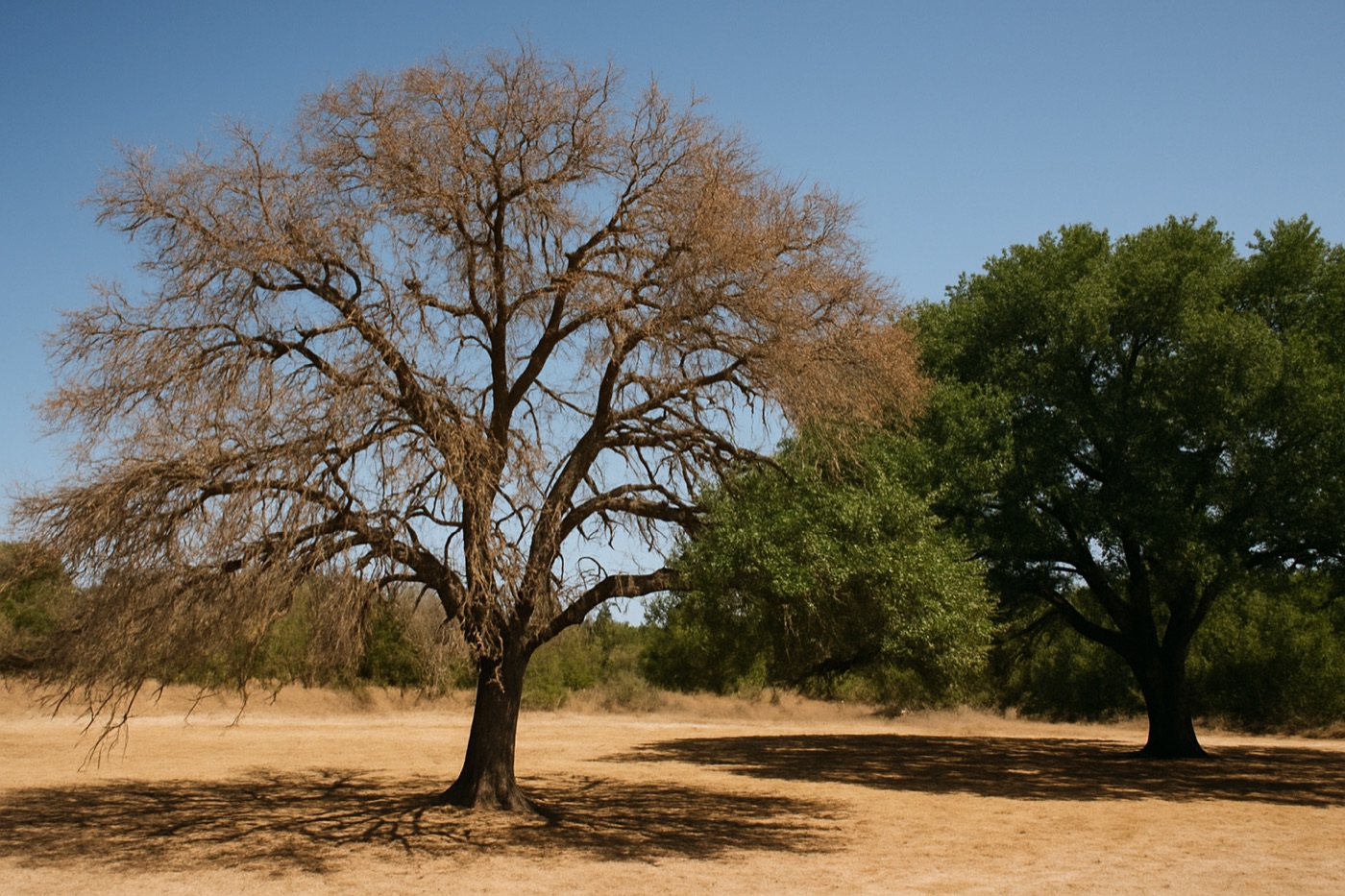
How oak wilt spreads — two ways, two speeds
Above ground: when a red oak (Spanish oak, blackjack) dies of oak wilt, fungal mats form under its bark. Sap-feeding beetles visit the mats, then visit fresh wounds on healthy oaks — a pruning cut, a broken limb, a mower scar — and start a new infection center. This is why timing and paint matter: don’t prune oaks February through June, and paint every oak cut immediately, all year. Below ground: live oaks in Central Texas grow as connected families, root systems grafted together. Once one live oak in a motte is infected, the fungus moves tree-to-tree through the roots at up to 75–100 feet per year. That’s how a neighborhood loses a whole streetscape from one bad February prune job three doors down.
What it looks like
On live oaks, the tell is veinal necrosis — leaves with yellow-then-brown veins while the rest of the leaf stays green for a while — and a canopy thinning over weeks to months. Most infected live oaks die within one to two seasons; a small share hang on. On red oaks, it’s faster and uglier: the whole crown wilts from the top, often in a few weeks, frequently in late spring or summer. A red oak that went from green to brown in a month is oak wilt until proven otherwise. Lab confirmation exists (a sample culture through Texas A&M’s plant clinic), and for a motte of mature live oaks it’s worth the certainty before anyone starts trenching.
What actually works — and what it costs
Trenching is the structural fix: a trench at least four feet deep cut around the infection center to sever the root grafts, placed 100 feet or more beyond the last symptomatic tree. Around here that’s $2,000–$5,000 depending on length, rock and access, and it’s the difference between losing three trees and losing thirty. Fungicide injection (propiconazole, injected into the root flare) protects individual high-value live oaks in the path of an advancing front — figure $20–$30 per inch of trunk diameter, so a 30-inch heritage live oak runs $600–$900, repeated on a 1–2 year cycle while the front is active. Injection protects that tree; it does not stop the underground spread. Removal of wilt-killed red oaks — with the wood chipped, burned or tarped on site, never hauled to a firewood pile — closes the mat factory. The wrong moves: pruning in season, unpainted cuts, moving infected firewood, and “wait and see” while a front walks through a motte at a hundred feet a year.
Help paying for it
The Texas A&M Forest Service runs an oak wilt suppression program that can cost-share qualifying trenching projects (historically up to half, capped), and their regional foresters will help delineate infection centers — a genuinely useful free resource for a neighborhood-scale fight. A local crew that knows the program can tell you quickly whether your situation qualifies and coordinate the paperwork. If several neighbors share one infection center, one properly-placed trench beats four badly-placed ones — and splits the bill.
Common questions
How much does oak wilt trenching cost?
Most residential trenching projects in Caldwell County run $2,000–$5,000, driven by trench length (it must ring the infection center 100+ feet beyond symptomatic trees), depth to 4+ feet, and what the machine hits. The Texas A&M Forest Service cost-share can offset qualifying projects.
Can an infected live oak be saved?
Sometimes — propiconazole injection gives symptomatic-early or at-risk live oaks a real chance, and some live oaks survive infection on their own. Red oaks, realistically, no. The honest framing: injection is for the trees you can’t replace, trenching is for the trees behind them.
Is it safe to buy or burn oak firewood?
Burn local, seasoned wood and you’re fine — seasoned wood with loose bark doesn’t harbor viable mats. The danger is fresh red oak from an unknown source: that’s how oak wilt rides into new neighborhoods. Never move wood from a wilt-killed red oak; chip it, burn it on site, or tarp it tightly through a summer.
Why do the pruning rules only apply to oaks?
The fungus (Bretziella fagacearum) infects oaks; the beetles that carry it feed on oak sap and oak fungal mats. Your cedar elm can be pruned in April without oak wilt risk. Your live oak shouldn’t be — and any oak cut, any time of year, gets paint.
Who confirms oak wilt officially?
The Texas Plant Disease Diagnostic Lab at Texas A&M cultures samples for confirmation, and Texas A&M Forest Service foresters assist with field diagnosis of infection centers. A good local crew will tell you when it’s clear enough to act and when it’s worth the lab’s certainty first.
Worried about a tree? Get eyes on it.
Tell us what you’re seeing — browning pattern, how fast, which trees. A local crew will call you back, usually the same day. Fast matters with oak wilt.
Got it — expect a call back shortly to talk through what you’re seeing.