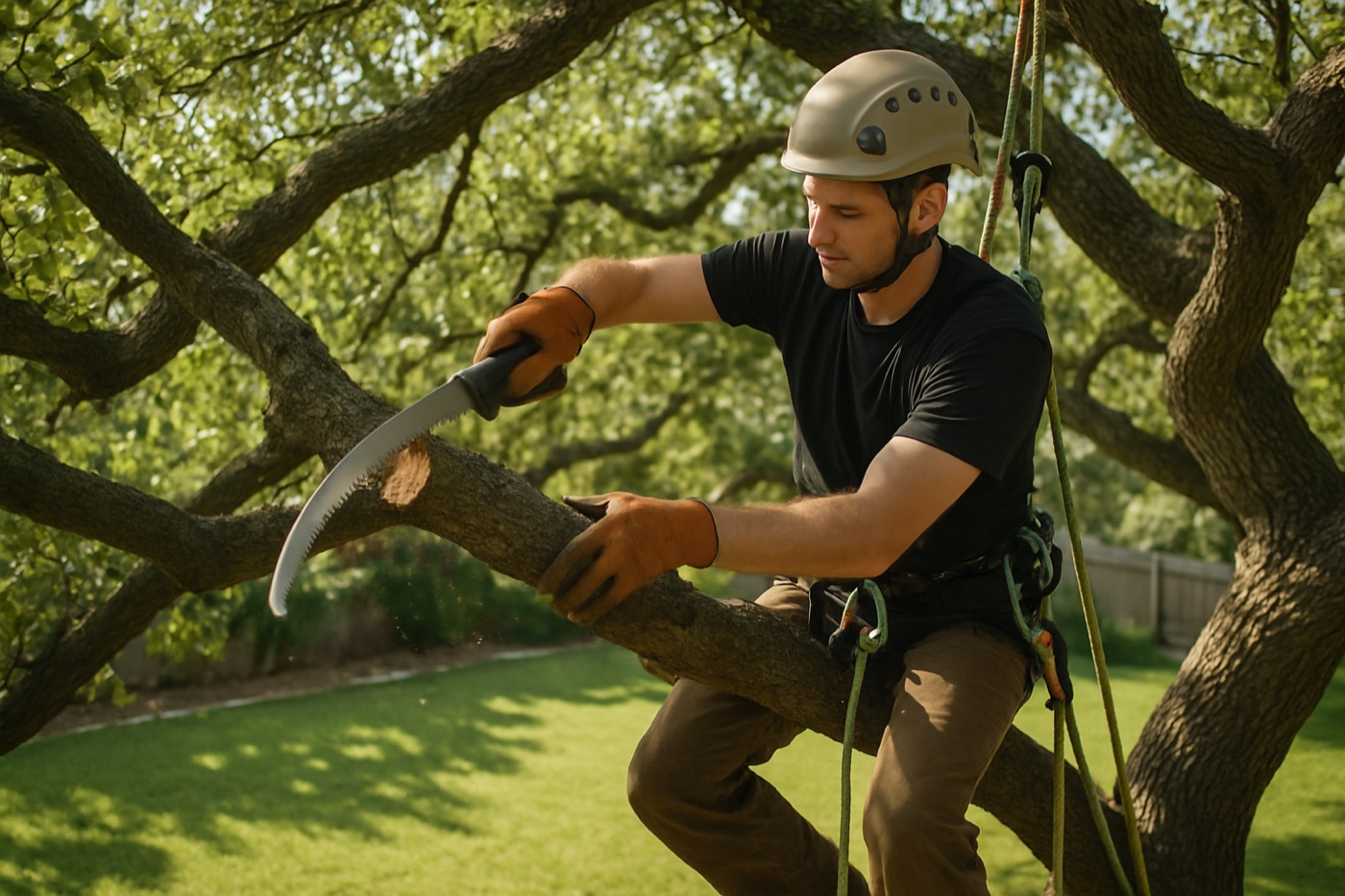
What a proper trim includes
A real prune around here is deadwood out (the limbs that come down in every storm), clearance (raised over the roof, the drive, the sidewalk — and away from service lines), structure (crossing and rubbing limbs, weak unions, the water sprouts post oaks throw after stress), and weight reduction on over-extended limbs — the long horizontal live oak limbs that eventually fail at the trunk. Cuts go at the branch collar, not flush, not stubbed. On a mature shade tree that’s $250–$700; a big courthouse-class live oak with a canopy across the whole yard runs $450–$1,200. On a 3–5 year cycle, that’s the cheapest insurance a tree owner can buy.
The oak rule: timing and paint
This is the part of pruning that’s different in Central Texas. Oak wilt moves to fresh cuts on oaks via sap-feeding beetles, so oaks get pruned July through January, not in the spring, and every oak cut gets painted immediately — any pruning paint works, applied the same hour. This isn’t folklore; it’s the Texas A&M Forest Service guidance, and it’s the first thing that separates a professional crew from a guy with a saw. If a bidder shrugs about timing or doesn’t carry paint, that quote is expensive at any price. Full detail on our oak wilt page.
Never topping. Ever.
Topping — cutting the canopy flat to “make it safe” or “let light in” — is how good trees become hazards. The tree answers with a broom of weakly-attached sprouts, the big cuts decay into the trunk, and in five years the tree is bigger, weaker and uglier than it started, with failure points at every old cut. No certified arborist tops trees. If a tree really is too big for its spot, that’s a reduction done to standard, or an honest conversation about removal — not a flat-top.
Crepe myrtles, pecans and the rest of the yard
Not everything is oaks. Crepe myrtles here get “murdered” every February by habit — stubbed to knuckles, which ruins the form and the bloom; a proper thinning does more with less. Bottomland pecans along the San Marcos River grow big, shed limbs by nature, and deserve professional weight management — a mature pecan limb is a serious object. Cedar elms and hackberries mostly need deadwood and clearance. A good crew treats each species like itself, not like a hedge.
Common questions
How much does tree trimming cost in Lockhart?
Most single mature shade trees run $250–$700. Large live oaks with big canopies run $450–$1,200. Multiple trees in one visit usually price better per-tree than separate trips — a whole-yard clean-up is worth quoting as one job.
When should oaks be trimmed here?
July through January. February through June is peak oak wilt transmission and non-emergency oak pruning should simply wait. Storm damage and hazards are the exception — cut when needed, painted immediately.
How often does a mature tree need trimming?
Every 3–5 years for most established shade trees — deadwood, clearance, and structural touch-ups. Younger trees benefit from more frequent, lighter structural pruning; it’s far cheaper to grow a good tree than to fix a bad one at 40 feet.
The power line runs through my tree. Who trims that?
The utility owns clearance around its lines — City of Lockhart electric in town, Bluebonnet Electric across much of the county. Limbs into the service drop to your house can be handled by a private crew with proper clearance from the utility. Nobody without line-clearance certification should be cutting near energized lines.
Get a free trimming estimate
Tell us what’s overgrown and where. A local crew will call you back — usually the same day.
Got it — expect a call back shortly to talk through the job and set up a look at the trees.